 |
In order to
preserve and promote the principles of one of the most popular styles of
karate in the world, as perceived by masters Funakoshi Gichin, Nakayama
Masatoshi and their students Enoeda Keinosuke, Abe Keigo and Sumi
Yoshikazu, the Japan Shotokan Karate Alliance‐]Great Britain (JSKAGB)
was set up at a meeting of like‐]minded individuals in January 2010.
Shotokan
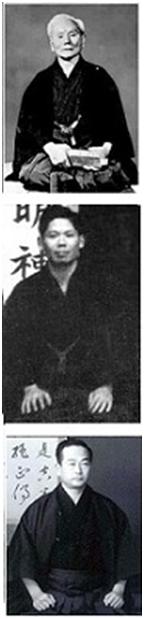
karate was founded by ‘O’ Sensei Funakoshi Gichin who was born in
1868 in Shuri, Okinawa who is described as the ‘Father of Modern
Karate’. As a young man he was a student of two very famous masters of
the martial arts, Anko Itosu and Yasutsune Azato. In 1922 he was invited
to Japan to give a demonstration of karate in front of the Emperor of
the time, at the First National Athletic Exhibition in Tokyo, which was
organised by the Ministry of Education. After this demonstration he
decided to remain in Japan to spread the word and due to his efforts,
karate became a part of the school curriculum in Japan. He built the
first Shotokan dojo in Tokyo in 1936 but it was sadly destroyed. The
style name ‘Shotokan’ was given to Funakoshi’s karate by his students.
Shoto was Funakoshi’s pen name as a writer, meaning ‘pine waves’ and Kan
means ‘school’ so those who trained at Funakoshi’s ‘school’ became known
as the Shotokan. The style was further influenced by his son Funakoshi Yoshitaka (Giko) 1906—1945,who was deemed to be the
technical creator and developer of modern karate, who greatly helped
developed Shotokan as we know it. Thus developing a karate style with
techniques that definitively separated Japanese Karate‐]do from the
local Okinawan art, giving it a completely different and at the same
time notoriously Japanese flavour. In 1948 Funakoshi and his students,
established the Japan Karate Association and he remained the head of the
JKA until his death in 1957.
Nakayama
Masatoshi sensei 10th Dan, born in 1913 in the Yamaguchi Prefecture
in Japan, became a student of Funakoshi Gichin after he entered the
famous Takushoku university in 1932 and was appointed the first JKA
headmaster in 1958, after the death of master Funakoshi. Nakayama Sensei
authored a great deal of textbooks on Karate, many of which are still
used today, and was primarily responsible for setting the standard of
the then JKA and thus the spread of Shotokan throughout the world. One
of the JKA instructors to be sent out by Nakayama to sow the seed of
Shotokan was Enoeda Keinosuke 9th Dan, who was the JKA representative
and Chief Instructor for Great Britain. Nakayama sensei passed away at
the age of 74 in the year 1987, leaving no successor, which led to a
major split amongst the JKA’s most senior instructors. This led to the
formation of another three major Shotokan groups, the Japan Shoto Renmei,
Tetsuhiko Asai 10th dan (died 2006), the Japan Shotokan Karate
Association, Keigo Abe 9th Dan and the Karatenomichi, headed by Mikio
Yahara 8th Dan |
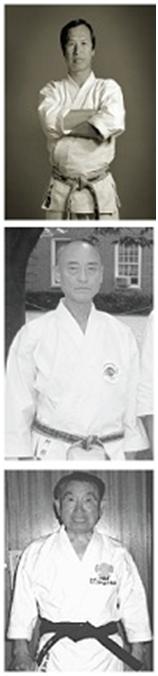 |
Enoeda Keinosuke, 9th Dan was the JKA representative and Chief Instructor for Great Britain. He was born in Fukuoka on the island of Kyushu in southern Japan on July 4th 1935 and practiced martial arts from an early age. While attending Takushoku University and after only two years training he passed his first dan black belt examination, and then two years later, aged 21, he was made captain of the Karate club. It was during his university training that he received instruction from the great master, Funakoshi Gichin. After graduating in 1957 with a degree in commerce, Enoeda was invited to take the special instructors course at the JKA headquarters. He accepted and for the next three years studied long and hard on a daily basis under Masatoshi Nakayama, the chief instructor of the JKA and Hidetaka Nishiyama, a leading senior. He won the JKA All Japan Championship in 1963 and during this period he and after Nakayama described his fighting he picked up the nickname "tiger" (tora in Japanese). He headed the Karate Union of Great Britain as well as the Karate Union of Scotland in his time, but sadly passed away in 2003.
Abe Keigo, 9th dan, born 1938 on Shikoku, Japan, was a direct student and confidante of Nakayama Masatoshi with whom he often assisted with his research. As a senior JKA instructor, he spent more than 35 years in the JKA Honbu, holding the office of both JKA Director of Qualification (presplit) and JKA Technical Director (Matsuno). A formidable tournament fighter in his day, he received many accolades while within the JKA and after he left to form the Japan Shotokan Karate Association in 1999. Abe sensei was one of the few instructors who could truly say that he taught Shotokan as developed and perceived by Nakayama, while headmaster of the JKA. A formidable fighter in his day, this was reflected in his time as a tournament competitor where he took 3rd place in the first JKA National Championships, was Captain of the Japanese team at the 2nd World Championships in Paris and took 1st place in 1973 at the JKA International Friendship Tournament, 1st place in the second Japan Karate Federation's (JKF) National Championships and 1st place in the third Japan Karate Federation's (JKF) National Championships. He currently heads the Japan Shotokan Karate Association.
Sumi Yoshikazu, 8th Dan was born in Shiritori, Japan on the 23rd June 1936. He started practicing karate at the age of 18 years at Keai University. His first karate teacher was Sensei Takaura, a senior graduate of the Japan Karate Association (JKA). He graded to Shodan (1st dan) in 1957 under Takaura sensei but formally joined the JKA in 1962 where he went on to teach the military on a US Airforce base in Japan. At the JKA's behest, he was sent into Europe as an assistant instructor, where he spent some time teaching in the UK in the late 60s with Enoeda sensei before moving to Italy to act for many years as assistant to Shirai Hiroshi 9th Dan. After the JKA split, he followed his heart and became an instructor and member of Asia’s faction of the JKA. Sensei Sumi still lives in Shiritori Japan, and is the official head of the Karate Union of Australia and The School of Traditional Karate in the UK and was formerly Technical Director to the Britain Netherlands Union of the JKA based in Holland. |
|